
Our History
"From the Roseburg Commercial Club in 1908 to today’s Roseburg Area Chamber of Commerce, our story has always been rooted in bringing people together to strengthen business, promote opportunity, and move Roseburg forward."

The Roseburg Area Chamber of Commerce has a story that reaches back more than 118 years.
Long before websites, newsletters, ribbon cuttings, and online directories, local business and civic leaders were already coming together around a shared belief: Roseburg’s future would be stronger if people worked together.
From the Roseburg Commercial Club to today’s Roseburg Area Chamber of Commerce, our story has always followed the needs of the local economy. In the early years, that meant promoting Roseburg, attracting investment, supporting agriculture, improving transportation, and helping residents choose local. As Douglas County grew, the Chamber’s work expanded alongside the industries and institutions that shaped the region: timber, healthcare, tourism, education, small business, infrastructure, and civic leadership.
Across more than 118 years, the tools have changed, but the purpose has remained remarkably consistent: bring people together, strengthen business, tell Roseburg’s story, and help our community move forward.
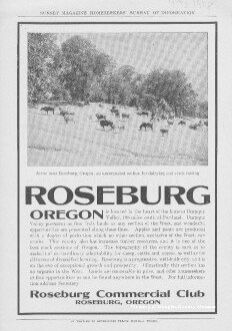
At the turn of the 20th century, Roseburg was growing into one of Southern Oregon's most important trade and business centers. Local business and civic leaders saw opportunity ahead, and they understood that progress would take organization, cooperation, and a shared belief in Roseburg's future.
In 1908, that spirit came together through the Roseburg Commercial Club, an early business and civic organization created to promote the town's growth, encourage investment, and help tell Roseburg's story beyond the community itself.
More than 200 citizens reportedly gathered in support of forming the club, and the first officers were elected on March 12, 1908.
Soon after the Commercial Club formed, local businessman George Kohlhagen agreed to build a headquarters for the organization in Downtown Roseburg. The second floor of the Kohlhagen Building on SE Jackson Street became the club's home, a place for meetings, planning, connection, and community momentum.
By January 1909, the club had moved into the new rooms. This space included offices, meeting areas, recreation rooms, a kitchen, lunch room, and gathering spaces. The headquarters was a reflection of the club's role as both a business organization and a community hub.
From its earliest years, the Commercial Club was focused on promotion. Its leaders worked to showcase Roseburg and Douglas County as a place of opportunity, a place to invest, settle, visit, and build.
In 1909, the club published thousands of promotional booklets about the area and distributed them at major regional events. It supported exhibits, advertising, and outreach designed to attract attention to the Umpqua Valley's agriculture, business potential, natural beauty, and quality of life.
The Commercial Club's work extended beyond traditional business promotion. Its members supported road and highway improvements, encouraged street lighting, recruited industry, promoted agriculture, and worked with farmers and community organizations.
This was Chamber work before it was called Chamber work: connecting people, promoting local opportunity, advocating for infrastructure, and helping the community imagine what Roseburg could become.
By 1914, the Commercial Club had become a powerful force in Roseburg's civic and business life. Historical documentation notes that the organization reached a high point of activity and influence around this time, with nearly 300 active members by the end of the year.
The club's work reflected a belief that Roseburg's success depended on people working together. Business owners, farmers, civic leaders, and residents all invested in the future of the community.
Following World War I, Roseburg's business leaders revived and reorganized the Commercial Club. On March 27, 1919, the organization passed a resolution, changing its name to the Roseburg Chamber of Commerce.
The name changed, but the purpose continued: to strengthen business, promote Roseburg, and support the growth and prosperity of the region.
Long before websites, social media, and visitor campaigns, the Roseburg Chamber of Commerce was already thinking about identity and promotion.
In 1926, the Chamber launched a slogan contest for Douglas County, inviting residents to help capture what made the region special. It was an early example of community branding, a shared effort to tell the world who we are and why this place matters.
During challenging economic times, the Chamber encouraged residents to support Roseburg merchants and manufacturers.
Through a "Buy Home Products" effort and a "No Peddler" campaign, the Chamber reminded the community that local purchasing protected local jobs, supported local wage earners, and helped keep Roseburg businesses open.
Nearly a century later, that message still feels familiar: when we choose local, we strengthen our community.
By the late 1920s, the Roseburg Chamber of Commerce was deeply involved in the practical work of regional development.
Archival records from this era show Chamber activity connected to agriculture, transportation, power and light rates, tourism, railroads, highways, timber revenues, newsletters, surveys, proposed businesses, and regional business advocacy.
These were not abstract topics. They were the building blocks of jobs, trade, transportation, investment, and opportunity across Roseburg and Douglas County.
In the 1930s, Roseburg's civic and business leaders worked to bring a new Veterans Administration Hospital to the community.
The hospital became a major regional institution, serving veterans across Oregon and Northern California and strengthening Roseburg's role as a service and employment center. It also reflected the kind of community advocacy that has long shaped the Chamber's work: identifying opportunities, bringing people together, and helping secure investments that benefit the region.
After World War II, timber helped define Roseburg's economy and identity.
Mills, forest products, trucking, equipment, construction, and related businesses supported families across Douglas County. Roseburg became known as the "Timber Capital of the Nation," a title that reflected not only an industry, but a way of life that shaped generations of local workers, businesses, and community investment.
The Chamber's story during this era reflects the community it served: a region where timber was central to jobs, families, industry, and local pride.
As timber became central to Douglas County's economy, the Chamber helped call attention to threats facing the industry.
In 1952, when billions of board feet of Douglas County timber were threatened by timber beetle damage, the Roseburg Chamber of Commerce urged the community to gather, discuss solutions, and protect one of the region's most important economic resources.
It was another example of the Chamber stepping into its role as a convener, bringing people together around issues that mattered to the local economy.
Transportation has always shaped economic opportunity.
In the 1950s, the Roseburg Chamber of Commerce supported improved highway connections between Roseburg and the coast, recognizing that roads moved more than vehicles. They made moving timber, goods, visitors, and workers possible.
Improved connections helped strengthen Roseburg's role as a regional business center and supported the industries that powered Douglas County.
On August 7, 1959, a devastating explosion damaged Downtown Roseburg and changed the community forever. Businesses were destroyed or displaced, and the recovery required resilience, cooperation, and local commitment.
The Roseburg Blast belongs in Roseburg's business story as a defining moment of loss, rebuilding, and community strength. It is a reminder that strong communities are not only built in moments of growth, but also in moments when people come together to recover and rebuild.
The Chamber's work has never been only about today's businesses.
In 1963, the Roseburg Chamber of Commerce sponsored the 29th annual 4-H Marketing Day, helping Douglas County students learn about marketing, business, agriculture, public services, and the local economy.
It was an early example of the Chamber investing in future leaders and connecting young people to the community around them.
In 1989, Project Leadership Roseburg began, creating a program designed to educate, connect, and inspire community-minded leaders.
Over the decades, the program has helped hundreds of participants better understand Douglas County, build relationships, and step into service across business, nonprofit, civic, and public life.
Leadership development remains one of the Chamber's most important roles because strong communities need informed, connected, and engaged leaders.
When the COVID-19 pandemic disrupted businesses and daily life, the Chamber became a resource hub for local employers.
Through recovery information, email updates, electronic communications, and partnership efforts, the Chamber helped businesses navigate one of the most uncertain economic periods in modern history.
It was a modern reminder of an old purpose: when business faces uncertainty, the Chamber helps bring information, connection, and support.
Even as the ways that people gathered changed, the Chamber continued creating spaces for information, leadership, and connection.
Programs such as the Economic Forecast, State of the County, Business Legislative Preview, State of the Timber and Wood Products Industry, and Project Leadership helped businesses stay informed and engaged during a rapidly changing time.
The Chamber continued to serve as a place where business, government, industry, and community could come together.
Today, the Roseburg Area Chamber of Commerce is building on more than a century of history while looking boldly toward the future.
With a renewed focus on connection, promotion, leadership development, advocacy, business resources, and community engagement, the Chamber is reimagining how it serves Roseburg and Douglas County in a changing economy.
The next chapter honors the same spirit that began in 1908: local people working together to create opportunity, strengthen business, and build a stronger community.
Carrying the Legacy Forward
More than 118 years after local leaders first came together through the Roseburg Commercial Club, the Roseburg Area Chamber of Commerce continues that legacy.
The tools have changed. The community has changed. The economy has changed. But the purpose remains familiar: to bring people together, strengthen local business, promote opportunity, and help Roseburg and Douglas County move forward with confidence.
Since 1908, our story has been rooted in one belief:
Stronger Business. Stronger Community. Stronger Roseburg.
A legacy more than 118 years in the making.